

Advertise a sales job anywhere in the Gulf and you will see the phrase "outdoor sales executive". It is a normal, well understood role across the region. To companies from markets where selling migrated to phone and video years ago, it looks like a throwback.
It is not. In Qatar it is frequently the only thing that works.
What is outdoor sales?
A representative travels to a prospect's premises, asks for the decision maker, presents in person, and leaves something behind, then returns. The distinction from inside sales or telesales is not the pitch. It is that the seller is physically there, repeatedly, in a defined territory.
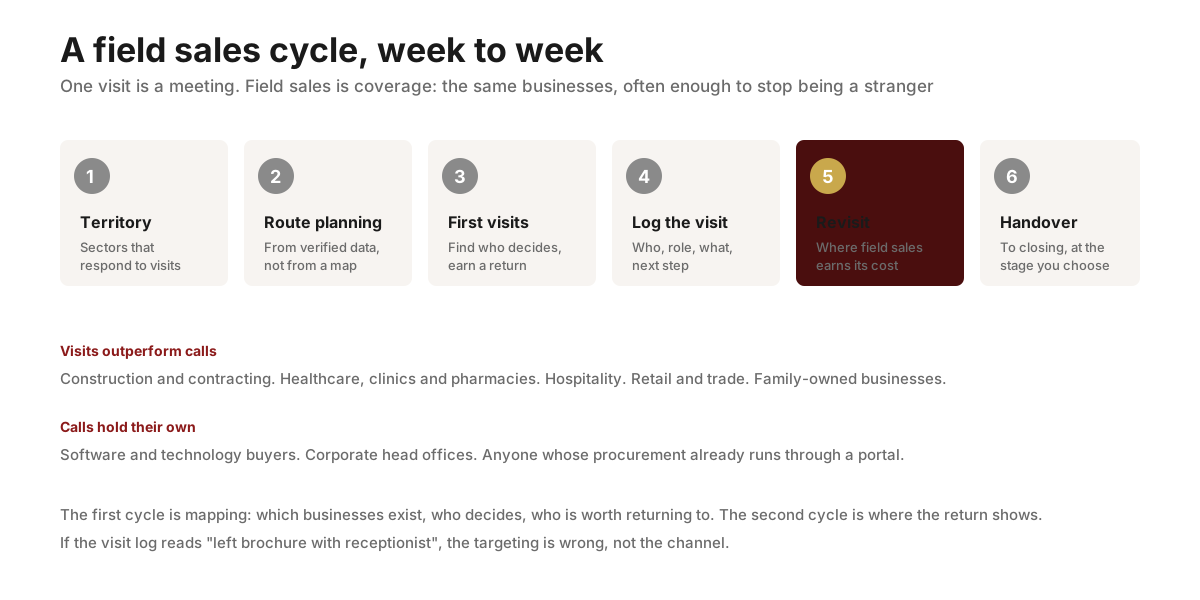
The distinction from a single sales visit is repetition. One visit is a meeting. Field sales is coverage: the same businesses seen often enough that you stop being a stranger.
Which sectors actually respond to visits?
Not all of them, and pretending otherwise wastes money. From what we see in the Qatari market, visits outperform calls most clearly where the buyer is not sitting at a desk with an open inbox:
- Construction and contracting. Site-based, phone-averse, and often reachable only by turning up at the site office.
- Healthcare, clinics and pharmacies. Gatekeepers screen calls heavily; a representative at the counter gets further.
- Hospitality. Procurement and F&B managers are on the floor, not on email.
- Retail and trade. Where the product needs to be seen, handled, or sampled.
- Family-owned businesses of any size. Where the decision maker is on site and relationships outrank procedures.
Where calls tend to hold their own: software and technology buyers, corporate head offices in West Bay, and anyone whose procurement already runs through a portal.
If your buyers are in the second group, a field team is the wrong instrument and we will say so.
What a week looks like
Route planning. Territory is divided so that a representative is not crossing Doha twice a day. Routes are built from verified business data rather than a map, so time goes on businesses that exist, still trade, and are the right size.
First visits. The realistic goal of a first visit is rarely a sale. It is finding out who decides, whether there is any need at all, and earning permission to come back.
Logging. Every visit recorded: business, person met, their role, what was discussed, next step. This is the part that separates a field team from a walkabout, and the part that is easiest to let slip.
Revisits. The accounts that showed interest get seen again. This is where field sales earns its cost, because familiarity is doing the work.
Handover. Interested accounts move to closing, either your team or ours. The relationship built on the doorstep is what the closing conversation is built on.
How to tell whether it is working
Revenue is a lagging indicator and a bad early one. Better questions, in the first weeks:
Are we reaching decision makers, or reception? If visit logs are full of "left brochure with receptionist", the targeting or the approach is wrong, not the channel.
Is the territory map filling in? Within a few weeks you should know, for your sector, which businesses exist, who decides, and which are worth returning to. That map is an asset even if the first cycle produces no revenue.
Are revisits converting better than first visits? They should be, substantially. If they are not, something in the follow-up is broken.
What are the objections? A field team hears the real ones, in plain language, far earlier than any other channel. That feedback is often worth as much as the pipeline.
Doing it yourself versus outsourcing
Employing your own field team means recruitment, visa sponsorship, vehicles, management, and end-of-service accrual, before a single visit happens. The hiring guide sets out what that involves.
Outsourcing means representatives who already know the territory, with no sponsorship or payroll commitment, and the option to stop. What you give up is direct day-to-day control.
The sequence that usually makes sense is the same as for any route to market: validate with an outsourced team, learn which sectors respond, then build your own once the volume justifies the fixed cost. That is the argument set out in the route to market comparison.
Common mistakes
Sending representatives without a target list. Walking a street is not a territory. Coverage should be planned against real data.
Judging it in month one. The first cycle is mapping. The second is where the return shows.
No visit record. If you cannot see who was met and what was said, you have bought activity rather than coverage.
Using it for the wrong sector. If your buyer sits in a head office and procures through a portal, spend the money on a different channel.
Related reading
Red Rock Directory fields outdoor sales representatives across Qatar, working from verified business data and reporting every visit. See field and outdoor sales or talk to our team.