

Once a company decides Qatar is worth pursuing, the next decision is who actually does the selling. There are three answers, and most companies choose between them on margin, which is the least important of the criteria.
What is the difference between a distributor, an agent, and a sales team?
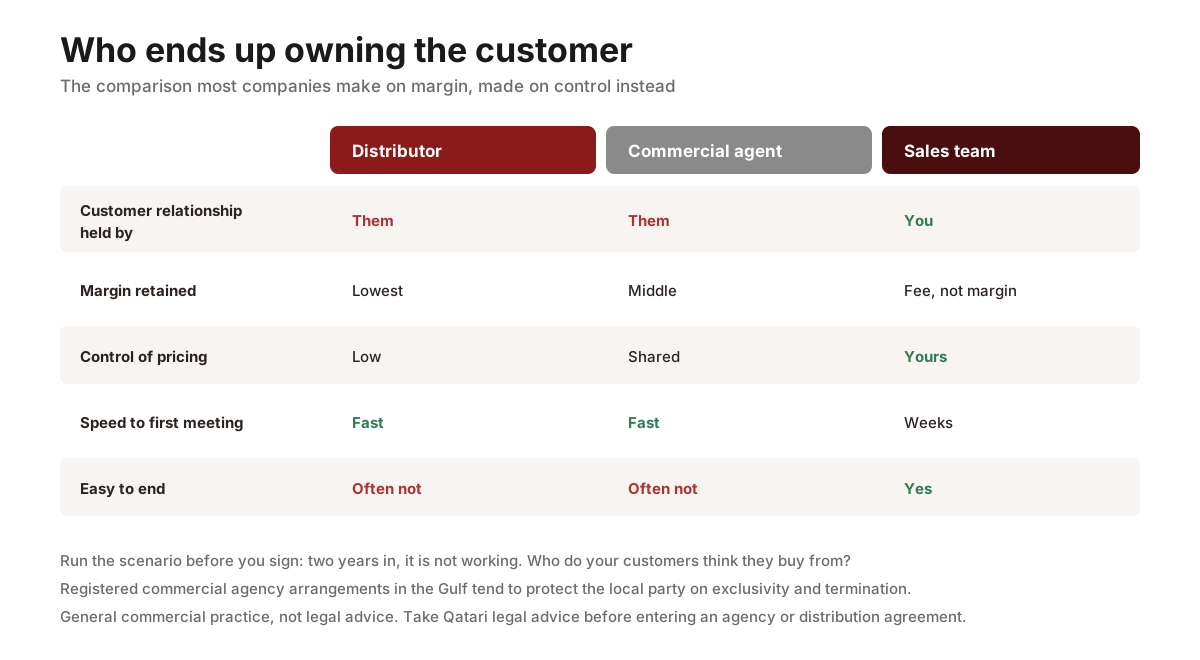
A distributor buys from you and resells on their own account. An agent sells on your behalf for commission without taking title. A sales team, whether employed or outsourced, sells as you. The commercial consequence is that the first two build their own relationship with your customer and the third builds yours.
The distributor
They buy, stock, resell, and usually service. You get reach without operational load.
What it costs you. Margin, obviously. But also the pricing conversation, the positioning, and the direct line to the end customer. Your product is presented alongside competing lines by someone whose incentive is total gross profit, not your growth specifically.
When it is right. Volume products, established categories, businesses where after-sales is genuinely local and physical, and any case where warehousing in Qatar is the hard part of the problem.
The trap. Exclusivity granted early. A distributor who has your exclusivity and stops performing is a much harder problem in the Gulf than in most markets, because the legal framework around registered commercial agencies tends to favour the local party on both exclusivity and termination.
The commercial agent
They introduce and sell on commission, without buying the goods.
What it costs you. Less margin than a distributor. But you inherit their reputation, good or bad, and their attention is divided across whatever else they carry.
When it is right. High-value, low-volume, specification-led sales where the relationship matters more than the logistics, and where you can still be in the room for the important meetings.
The trap. The same one. Registered agency arrangements carry legal protections that a normal contract does not, and they are not easily reversed. Take Qatari legal advice before signing anything with the word exclusive in it.
Your own sales team, employed
You recruit, sponsor, manage and pay people in Qatar.
What it costs you. Real money and real time before any revenue. Recruitment, visas and sponsorship, salaries, end-of-service accrual, management attention from a head office in a different time zone. The hiring guide covers what that actually adds up to.
When it is right. Once volume justifies it and the market is proven. It is the correct end state for a business with real traction.
The trap. Doing it first. Building a team to discover whether the market exists is an expensive way to find out.
An outsourced sales team
A team already in Qatar sells into a list you approve, and hands you the contracts and the contacts.
What it costs you. A fee rather than a margin, and less day-to-day control than employing people directly.
When it is right. When you want people in the market quickly without the commitment of either an agency agreement or a payroll, and when the customer relationship needs to end up with you. It is the route that keeps your options open, which is worth a great deal in a market you are still learning. This is what our sales representatives do, with outdoor sales visits where buyers respond better to being visited than called.
The question most companies skip
Not "which is cheapest" but "who has the customer if this ends badly?"
Run the scenario. Two years in, the arrangement is not working. With a distributor or a registered agent, your customers know them, are invoiced by them, and may be contractually theirs. You are starting again, possibly while still bound.
With a sales team, employed or outsourced, the contacts, the meeting history and the contracts are yours. You change who does the selling; you do not change who the customer belongs to.
That asymmetry is worth more than a few points of margin, and it is invisible on the spreadsheet where these decisions usually get made.
A reasonable sequence
For most companies entering Qatar without an existing local relationship:
- Validate with outsourced representation. Real meetings, real feedback, no long-term commitment.
- Commit once you have signed contracts rather than projections, choosing the structure that fits what you learned.
- Employ when volume justifies the fixed cost, taking the pipeline with you.
Skipping straight to step three is how companies end up with an expensive team selling into a market nobody validated. Skipping to an exclusive distributor is how they end up unable to change course.
This article describes general commercial practice, not legal advice. Commercial agency and distribution arrangements in Qatar carry specific legal requirements and protections, take advice from a qualified Qatari adviser before entering one.
Red Rock Directory provides the middle route: sales representatives on the ground in Qatar, representing you in person and handing you the relationships. See sales representatives or talk to our team.