

Most companies arrive at the same question in the same order. They see demand in Qatar, they price up company formation, and then someone asks whether all of that is necessary just to find out whether the market is real.
It usually is not necessary, at least not first. There are four practical routes to a Qatari buyer, and the interesting differences between them are not cost. They are control, speed, and who owns the customer at the end.
Can a foreign company sell into Qatar without a local entity?
In many cases yes, through a local intermediary or a representation arrangement, though what is permitted depends on your sector, your product, and how the contract is written. Some activities are restricted, some require licensing regardless of who fronts them, and government procurement in particular has its own registration requirements that a workaround does not remove.
That is the honest answer, and anyone who gives you a flat yes without asking what you sell is not worth listening to. What follows is the commercial shape of each route. The legal structure for your specific case belongs with a Qatari adviser.
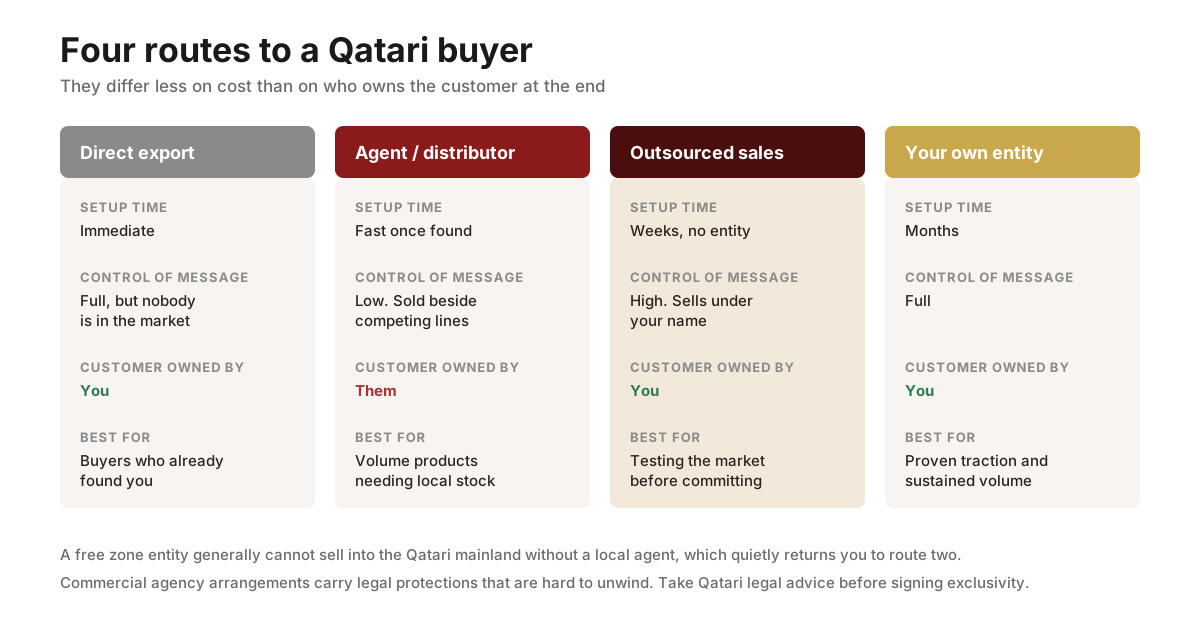
Route one: direct export, no presence
You invoice from home and ship in. The buyer handles import, or you sell on delivered terms and use a freight forwarder.
This works when the buyer already knows they want your product, which in practice means they found you, not the other way round. It is a fulfilment route, not a growth route. Nobody is in Qatar creating demand, so your pipeline is limited to whoever happens to search for you.
Worth doing while you evaluate. Not worth mistaking for a market entry strategy.
Route two: a commercial agent or distributor
You appoint a Qatari company to represent or resell your product. They have the relationships, the licence, and often the warehouse.
The upside is speed. A good distributor has been selling to your target buyers for years and can open doors that would take you eighteen months to reach cold.
The downside is the one people underestimate: the relationship belongs to them, not you. Your customers know their salesperson, their invoice, their after-sales contact. If the arrangement ends, you are not taking that pipeline with you, and you may find you cannot easily appoint a replacement.
This is also the route with the most legal weight around it. Registered commercial agency arrangements in the Gulf are generally protective of the agent, and exclusivity and termination terms are much harder to unwind than a normal supply contract. Get the agreement drafted by someone who does this in Qatar specifically, and be careful about signing anything exclusive before you know the partner well.
Route three: outsourced sales representation
A team based in Qatar sells into a target list you approve, and hands you the contracts and the contacts.
This is the middle route and the least well known. You get people physically in the market, meeting buyers, presenting in Arabic where that matters, without recruiting anyone, sponsoring any visas, or committing to a distributor relationship you may not be able to exit. Because they represent you rather than reselling, the customer relationship stays yours.
It suits companies that want to find out whether Qatar works before committing capital to it, and companies whose remote sales calls keep stalling for reasons nobody at head office can quite diagnose. This is the service our sales team in Qatar provides, and where the buyers are best reached on their own premises, our field and outdoor sales representatives do the visiting.
Route four: your own entity
Mainland, free zone, or QFC, each with different ownership rules, tax treatment, and market access. This is the full commitment and eventually the right answer for a business that finds real traction.
It is covered properly in the free zone vs mainland vs QFC guide, including the trap that catches most people: a free zone company generally cannot sell into the Qatari mainland without routing through a local agent, which quietly reintroduces route two.
How do you choose between them?
Ask three questions, in this order.
Do you know the market is real? If you are still guessing, do not build an entity to find out. Test with representation, then commit once you have signed contracts rather than projections.
Who do you need to own the customer? If your model depends on renewals, upsells, or direct service relationships, handing the customer to a distributor works against you from day one. If your model is volume through channel, it may not matter.
How reversible does it need to be? Representation you can stop. A registered exclusive agency you may not be able to, quickly or cheaply. Weigh that before signing, not after.
Common mistakes
Signing exclusivity to secure a first customer. The customer is worth less than the exclusivity costs you, almost every time.
Treating registration as the finish line. A registered entity with no relationships and no route to decision makers exists on paper in Qatar and nowhere else.
Assuming your home sales motion transfers. It usually does not. The Qatari B2B sales cycle runs on relationships and in-person meetings in ways that email sequences and demo calls do not reach.
This article describes general commercial practice and is not legal advice. Commercial agency arrangements, licensing, and sector restrictions in Qatar have specific legal requirements that differ by activity, always take advice from a qualified Qatari adviser before signing.
Red Rock Directory helps international companies reach Qatari buyers, with verified business data, managed outreach, and sales representatives on the ground who meet them in your name. Talk to our team or see how sales representatives work.