

Tax is usually the first question a foreign board asks about Qatar and the last one that gets a straight answer. This guide sets out the rates that actually apply, who each one applies to, and the two features of the Qatari system that most often surprise newcomers.
How much corporate tax does a foreign company pay in Qatar?
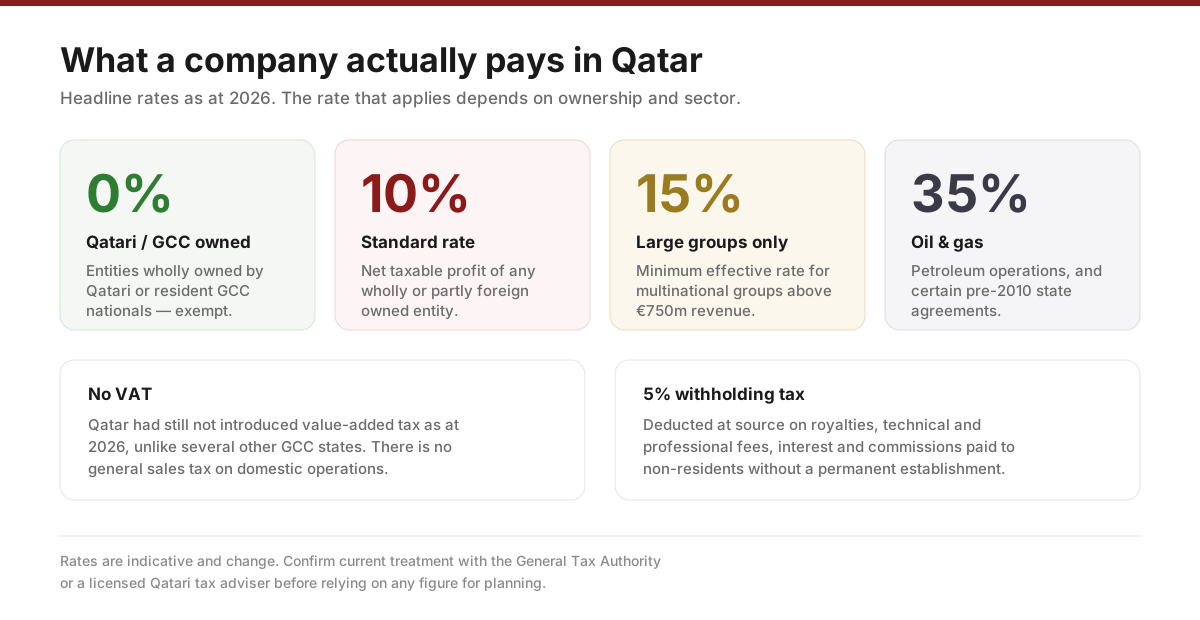
A company with any foreign ownership pays 10% corporate income tax on its net taxable profit generated in Qatar. Entities wholly owned by Qatari nationals or by resident GCC nationals are currently exempt from corporate income tax. Higher rates apply in specific cases: petroleum operations are taxed at a minimum of 35%, and certain agreements concluded with the state before 2010 carry their own rates.
The 10% figure is the number to plan around for almost every ordinary commercial activity, consultancy, trading, technology, logistics, contracting, professional services.
Does Qatar have VAT?
No. As at 2026 Qatar had still not introduced value added tax, despite a GCC wide framework agreement and the fact that several neighbouring states implemented VAT years ago. There is no general sales tax on domestic operations.
This matters more than it first appears. If you are modelling a Qatari entity against a Saudi or Emirati one, VAT registration, filing, input recovery and cashflow simply do not appear in the Qatari column. It also means pricing comparisons across the Gulf are not like for like.
VAT has been discussed repeatedly and could be introduced. Treat its absence as the current position, not a permanent guarantee.
What is withholding tax in Qatar and when does it bite?
Qatar applies a 5% withholding tax on certain payments made to non-residents who have no permanent establishment in the country. It covers royalties, technical and professional service fees, interest, and commissions. The payer deducts the tax at source and remits it to the General Tax Authority.
This is the rule that most often catches foreign groups out, because it applies to money leaving Qatar rather than profit earned inside it. Common triggers:
- Paying a parent company abroad for management or technical support
- Licensing software or IP into the Qatari entity from overseas
- Paying an overseas consultant or agent a commission on a Qatari contract
The exposure is not the 5% itself, it is discovering after signature that the contract was priced without it, and that the Qatari entity is the one legally obliged to deduct.
What is the 15% minimum tax and does it apply to us?
Qatar introduced a global minimum tax through Law No. 22 of 2024, published on 27 March 2025, adopting the OECD Pillar Two framework at a 15% minimum effective rate. It applies to multinational enterprise groups with consolidated annual revenues of at least EUR 750 million, and takes effect for fiscal years beginning on or after 1 January 2025. Detailed implementing rules followed in Council of Ministers Resolution No. 2 of 2026, issued on 12 February 2026.
For most companies reading this, the honest answer is: it does not apply to you. The EUR 750 million threshold excludes the overwhelming majority of businesses entering the Qatari market.
If your group is above that threshold, the mechanism matters. Qatar's Domestic Minimum Top Up Tax means that where the effective rate on Qatari income falls below 15%, including through incentives, the shortfall is collected in Qatar rather than surrendered to another jurisdiction. In practice, incentive led structuring is worth substantially less to in-scope groups than it was before 2025.
The three mistakes that cost the most
Assuming ownership structure is only a licensing question. It determines your tax rate. The gap between a wholly Qatari owned entity and a foreign owned one is the difference between exemption and 10% on every riyal of profit.
Pricing cross border contracts without withholding tax. Decide who bears the 5% before signature, and write it into the contract. Renegotiating afterwards is expensive and slow.
Treating "no VAT" as "no compliance". Corporate income tax registration, filing and audit obligations exist regardless. The absence of VAT removes one filing stream, not the administration.
What to do before you commit
- Fix your ownership structure first, it drives the rate, not the other way round
- Map every recurring payment that will leave Qatar and test each against the 5% withholding rules
- Confirm whether your group crosses the EUR 750 million Pillar Two threshold
- Verify current rates with the General Tax Authority or a licensed Qatari adviser before relying on any figure
Tax rules change, and the Pillar Two rules in particular are still bedding in across the Gulf. The figures here reflect the position as at August 2026 and are general information, not tax advice for your specific situation.
Red Rock Directory provides a verified Qatar business directory and market entry support for international businesses working in Qatar. If you are assessing the market, talk to our team or browse the directory to see who is already operating in your sector.